

Montana State University, continued commitment to economic engagement
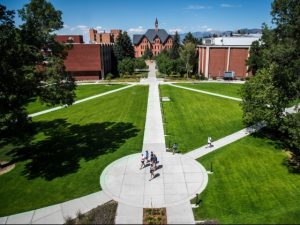
Montana State University is pleased to receive a five-year extension of our APLU Innovation and Economic Prosperity Designation. As stated in our press release on the extension, the University views this designation as the beginning of our work in economic engagement, not the conclusion. Since our original designation in 2016, Montana State University and the greater Bozeman region have undergone significant change.
First, the University has hired a full-time Director of Economic Development and Impact to drive the economic engagement work forward. The position allows the University to increase its focus on economic development and provides a single point of contact for outside groups and companies.
Second, the Gallatin Valley region has seen a significant increase in population and the cost of housing. Additionally, our region has had a very tight labor market with an unemployment rate around 2% since the COVID-19 pandemic. Certain local industries have experienced exceptional difficulty in hiring to fill vacant positions. To respond to local needs, the University’s two-year college, Gallatin College, has created several new programs including Cybersecurity, HAVC-R, and Healthcare Administrative Professional. In addition, the University has secured a funding commitment from the Legislature for a new, state-of-the-art building for Gallatin College.
Even with the local challenges, innovative sectors such as the photonics industry have found opportunities to thrive right here in Bozeman. Photonics and quantum now employ more than 1,000 people and there are more than 45 companies in Montana. In fact, the Economic Development Agency (EDA) recently designated Montana as a Regional Technology and Innovation Hub focusing on photonics and sensing technology called the Headwaters Tech Hub. In early July, Montana State received notice that Headwaters Tech Hub had been awarded $41 million over ten years to work on projects in the Tech Hub proposal. Montana State is intimately involved in three of the five projects that were funded. An outgrowth of Montana State’s expertise in photonics is an expansion into the quantum field with a primary focus on materials and supply chain.
Further, Montana State continues to expand our research enterprise from $107 million in expenditures in FY16 to $230 million in expenditures in FY23. University staff expects that number to increase further in FY24. The University continues its designation as a Carnegie R-1 institution and is one of only two R-1 universities with a very high undergraduate enrollment profile.
Additionally, the University continues to contribute to the creation of “place” in our community. In our 2016 application, Montana State noted plans to construct a building on campus focused on our Native communities. In 2021, the University opened American Indian Hall and it remains one of the premier facilities on campus. Further, the University has continued to invest in projects including new buildings for our School of Nursing, School of Computing, and a hotel on campus to support our hospitality programs. These buildings advance not only the University’s academic missions, but also will benefit the community in many ways including several outward facing spaces.
Montana State University remains committed to our tri-partite mission as a land-grant institution–educating students, conducting research, and outreach to our local and statewide community.
The University views on-going economic engagement as essential to all those missions.
Montana State University has remained actively engaged with economic development efforts both in our state and nationally. Staff and faculty serve on the board of several local non-profits focused on improving the economic lives of the community including, but not limited to, the Montana Photonics and Quantum Alliance, the Southwest Montana Manufacturing Partnership, the Montana Economic Developers Association, and Prospera Business Network. The University routinely hosts or sponsors events related to economic development including the first-of-its-kind Montana Festival this Spring.
As a cornerstone of our five-year extension application the University engaged internal and external stakeholder groups. The University spoke with three internal groups. Each internal group focused on one of the three categories laid out for IEP–Talent, Innovation and Place. The Gallatin College Advisory Board focused on Talent. The University’s Center and Institute Directors focused on Innovation. Representatives from the University’s Extension Program and School of Agriculture focused on Place.
The University followed the same model for our external engagement. For the Talent category, the University solicited advice from the Southwest Montana Manufacturing Partnership. The Montana Photonics and Quantum Alliance board members were asked to focus on Innovation. The City of Bozeman Economic Vitality Board focused on Place.
Many themes emerged from the engagement process, but we would like to draw attention to a quote from City of Bozeman Economic Vitality Chair Katy Osterloth, “It [Montana State University] is such a big piece of the community that I cannot even separate them out…I always credit MSU with why Bozeman is lively…for me, they [Bozeman and Montana State University] are so intertwined.”
Additional themes emerged across all the conversations. The first was a need to strengthen the talent pipeline at all levels including training for mid-career and executives. Second was the current frustration with issues such as affordable housing and childcare. A third theme that emerged was a request for more direct engagement from the University. Many stakeholders commented that they were unaware of the efforts outlined by Montana State staff. A final theme that emerged was to perform sustainable, long-term focused economic development rather than short-term focused efforts.
Looking forward, Montana State University is in the process of establishing an internal Economic Development Council and creating Economic Development goals. These goals will shape our engagement with external stakeholders. We are adding staff focused on economic development and plan to launch a corporate engagement strategy in the coming months.
Authors:
- Alison Harmon, PhD; Vice President of Research and Economic Development
- Mike Veselik; Director of Economic Development and Impact
- Commission on Economic & Community Engagement
- IEP
Stay Connected
X (formerly Twitter)
Facebook
YouTube
LinkedIn
RSS