


2026 IEP Designee – Jackson State University
We Didn’t Start New Work. We Finally Aligned It: What the IEP Process Revealed at Jackson State University
Authors:
- Almesha L. Campbell, Ph.D., Vice President for Research and Economic Development
- Tangelia Kelly, Ph.D., Chief Communications Officer and Executive Director of University Communications
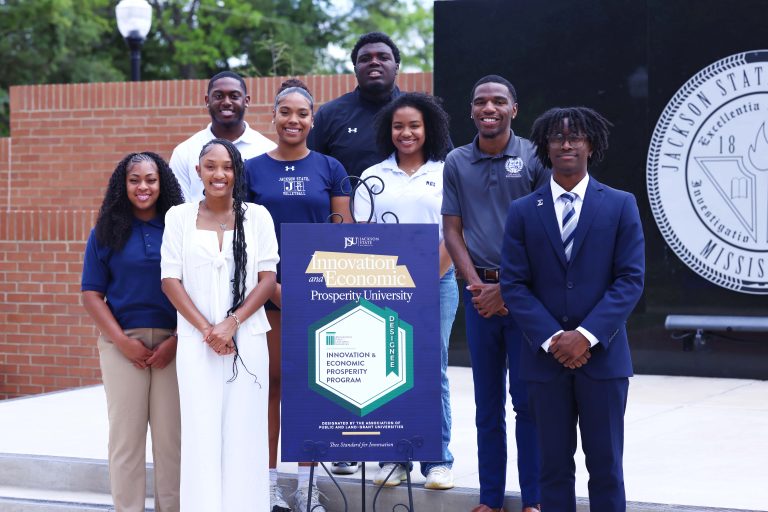
At Jackson State University, earning the Innovation and Economic Prosperity designation was not the hardest part. The harder work was organizing, aligning and clearly explaining efforts that had been building across the institution for years.
As Mississippi’s only urban research university and a historically Black university in the capital city, JSU operates in a region where economic engagement is lived, local and immediate. Talent retention, workforce alignment and limited in-state innovation capacity directly affect students, partners and the state’s long-term economic outlook.
We approached the IEP self-study by asking how the work actually connects, rather than simply listing programs. The process included surveys, customer discovery interviews and stakeholder engagement sessions with internal and external partners.
It confirmed what many already believed: JSU is a trusted community anchor with strong partnerships and a growing innovation ecosystem grounded in talent development, inclusive innovation and place-based engagement.
It also revealed something more practical. We were doing the work well, but we were not explaining it well.
That gap surfaced quickly during stakeholder engagement. External partners acknowledged JSU’s impact, but many reported limited awareness of the full scope, scale and outcomes of the university’s economic engagement work. That disconnect between impact and visibility became a turning point in how the university approached both alignment and communication.
At that stage, the Division of Research and Economic Development partnered with University Communications to translate research and innovation into more accessible formats. This included patent-driven stories, media releases, digital campaigns, photography and video content that illustrate real-world impact for audiences less familiar with research terminology. These efforts helped move innovation beyond technical audiences, making research outcomes, including patents and emerging technologies, more visible, understandable and relevant to external partners and communities.
The university’s economic engagement activity spans multiple units, including the Division of Research and Economic Development, the Center for Innovation, Entrepreneurship and Economic Development, the Office of Community Engagement, the College of Business and the Office of Innovation Management.
Across these areas, JSU has conducted thousands of business counseling sessions and supported the creation of hundreds of businesses over time, while also training innovators and entrepreneurs through programs such as NSF I-Corps.
The IEP process pushed us to ask a different question: are these efforts coordinated in a way that partners can easily navigate and access? That realization changed how we approached the designation.
As a result, JSU’s Growth and Improvement Plan focused on three priorities: institutionalizing stakeholder partnerships, scaling workforce and economic development infrastructure and improving communication, data and impact measurement.
This work is already taking shape. The Small Business Incubator is being developed as a centralized space for entrepreneurs, providing access to offices, co-working space, training and support for students, faculty, staff and community entrepreneurs.
Workforce initiatives are also being aligned more intentionally, connecting academic programs, industry partnerships and credential pathways to strengthen in-state workforce outcomes. Programs tied to cybersecurity, artificial intelligence, public health informatics and energy systems are part of that broader talent strategy.
At JSU, communication helps partners find the work, understand how it connects and identify where to engage. If partners cannot clearly see the work, understand how it connects or identify where to engage, then even strong programs are harder to scale. In response, we strengthened how we use storytelling, digital platforms and public engagement to connect programs to outcomes and partnership opportunities.
For institutions considering or pursuing the IEP designation, one takeaway is clear: the value is not in describing what you do. It comes from understanding how the work fits together and whether others can navigate it.
For JSU, the designation is a milestone. The larger impact is the clarity it created. We now have a stronger understanding of where we lead, where we partner and where we need to build more durable systems to support long-term economic engagement.
The work was already there. The IEP process forced us to organize it, align it and make it easier for others to find, understand and build on.
Authors:
Almesha L. Campbell, Ph.D., Vice President for Research and Economic Development
Tangelia Kelly, Ph.D., Chief Communications Officer and Executive Director of University Communications
 Almesha L. Campbell, Ph.D., Vice President for Research and Economic Development
 Tangelia Kelly, Ph.D., Chief Communications Officer and Executive Director of University Communications
All images are courtesy of Jackson State University
- Commission on Economic & Community Engagement
- IEP
Stay Connected
X (formerly Twitter)
Facebook
YouTube
LinkedIn
RSS