
A Field Guide to the Academic Programs Section (APS)
Contents
Academic Programs Section (APS)-What is it?
The Mission of APS
The Vision of APS
Academic Committee on Organization and Policy (ACOP) – What is it?
What Does APS Do?
Some Challenges for Academic Programs
What Meetings Should I Attend?
Membership Directory
Academic Programs Section (APS)– What is it?
The Academic Program Section (APS) is comprised of the principal officer(s) responsible for academic or instructional programs (undergraduate, graduate, and continuing education) offered by the faculty within colleges of agriculture and related disciplines. It is one of five sections within the Board on Agriculture Assembly (BAA) of the Association of Public and Land Grant Universities (APLU). The others are agInnovation (formerly the Experiment Station Section), the Extension Programs Section, the Administrative Heads Section, and the International Programs Section.
Academic Programs Section members represent 120 different institutions that include the 1862 land-grants, 1890 land-grants, 1994 land-grants, and 6 non-land-grant institutions. It also includes the 450+ institutions belonging to the Non-land-grant Agriculture and Renewable Resources Universities (NARRU). The NARRU organization and its institutions are affiliate members of APS. Thus, in total, APS represents 160+ institutions having academic programs in agriculture, natural resources, life, and related sciences.
There are four regional sections of APS, the south, northeast, north central and west, and each of these are represented by an officer (i.e., Past President, President, President-Elect and Secretary) on the Executive Committee. Elected officers have a 4-year commitment to the Executive Committee that begins with their tenure as secretary and progresses through president-elect, president and past president positions. A region ensures its representation on the APS Executive Committee by electing a new APS secretary once every four years.
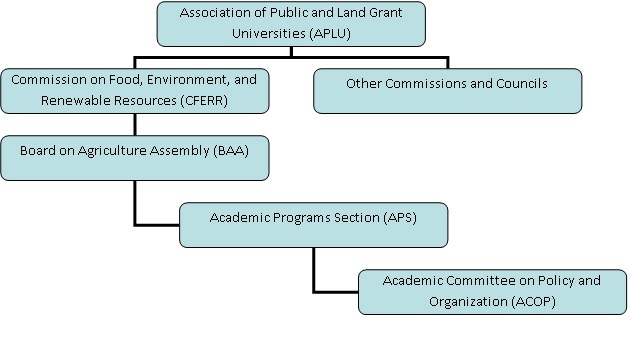
The Academic Program Section’s position in the APLU organizational chart is shown below.
To assure that the development of human capital in agriculture, food, natural resources, life sciences and related areas is a preeminent concern of the Land-Grant System and its federal partners.
To provide academic instruction and other programs that prepare society-ready graduates with the skills and competencies necessary to sustain and enhance the food, agriculture and natural resource and life science systems needed by professionals and the general public. This involves the engagement of faculty in the development and implementation of relevant undergraduate and graduate curricula, establishing effective advisement systems for students and the mentoring of faculty to become accomplished teachers in a learning community environment.
Academic Committee on Organization and Policy (ACOP) – What is it?
ACOP is a part of APS that serves as a steering committee/board of directors for the Section. All ACOP members are APS members but not all APS members are ACOP members. ACOP’s membership is comprised of 23 individuals that includes:
- The Executive Officers of APS (Chair, Chair-Elect, Past Chair, Secretary)
- The Chair and Chair-elect for each of the four APS regions
- A Representative from 1890s, 1994s, & NARRU
- The APS Representative to the BAA Policy Board of Directors
- The Chair of the APS Program Planning
- The APS Representative to the BAA Budget and Advocacy Committee
- The APS Representative to the BAA Committee on Legislation and Policy
- The Executive Director of Academic Programs (APLU)
- The CARET liaison representative to ACOP
- A Representative from the Board on Human Sciences.
ACOP is the policy-recommending body of APS and responds to issues, internal or external, that require an ‘official’ position. For example, this could involve establishing the budget priorities for academic programs or taking a position on the proposed federal budget lines in the USDA NIFA Budget. ACOP represents APS as it cooperates with the other sections and members of the BAA and the various APLU commissions and councils to develop and participate in national academic initiatives and forums. The Experiment Stations (ESCOP), Extension (ECOP) and International Programs (ICOP) have parallel Committees on Organization and Policy.
Wendy Fink currently serves as Executive Director of Academic Programs Section and Assistant Vice President for Food, Agriculture and Natural Resources. Her office is housed within the APLU suite in Washington, DC. She represents ACOP and APS to the APLU leadership and is the lead spokesperson for APS. Tara Westington is the Senior Associate for Food, Agriculture and Natural Resources and assists with APS programming.
Provides a national structure that:
1. Identifies and addresses national trends and issues (for example, conducts manpower [supply/demand] studies identifying needs in the professions);
a. Provides input to USDA NIFA regarding the role of human capacity development for USDA’s initiatives in education and farm bill implementation.
b. Identifies and addresses funding challenges and opportunities (for example, the ongoing exploration of new liaisons with the Department of Homeland Security and the Department of Energy);
c. Fosters regional collaborations among member institutions and coordinates these with programs of federal partners, business and industry, other state and local government and non-government partners;
d. Champions excellence in college and university teaching through the national Teaching Excellence in Colleges and University Teaching Awards Program and the support of regional teaching effectiveness/improvement workshops;
e. Fosters collaborative efforts with international organizations whose goals parallel those of APS (for example, the ongoing collaboration with the Interuniversity Consortium of Agriculture and Related Sciences [ICA] in Europe);
f. Collaborates with other BAA sections to mount multi-state and national programmatic, legislative, and funding initiatives;
g. Works with lobbying representatives to insure growth of federal funding for academic programming via USDA Challenge, Graduate Fellowship, Multicultural Scholars, and Capacity Building grant programs and identify new funding mechanisms for higher education in the food, agriculture, natural resources, environmental, life and related sciences.
2. Provides continuing professional education for members – to assure the development of the leadership necessary for the future – through APS Meetings (at the APLU Annual Meeting and the Joint APS/NARRU Winter Meeting), the regional teaching workshops, summer workshops, national (e.g. Academic Summit 2006: “Opportunities for Academic Leadership –Preparing Society Ready Graduates”), international conferences, and the ESCOP/ACOP Leadership Development Program (for example, workshops have included topics such as “Outcomes Assessment for Program Improvement”, “Assisting Faculty in Instructional Improvement”, “Utilizing Technology in the Creation of Learning Environments”, etc.)
3. Assists members with the tools to recruit and retain a student population and to develop and deliver academic programs to prepare professionals to meet the needs of our agriculture, food and natural resource systems.
4. Works to secure increased resources for higher education from federal, state, and local governments and from the private sector.
What Meetings Should I Attend?
APLU Annual Meeting
This meeting occurs annually in the fall (ie early November) at different locations throughout the U.S. It addresses educational issues of national concern and APS meets for one-half day during this meeting. ACOP members also meet for one-half day in advance of the APS meeting.
Mid-Winter Meeting
The mid-winter meeting occurs annually in late February/early March and is held in Washington DC. It is a 1.5 day meeting. ACOP holds a meeting in advance of the larger APS gathering.
BAA Leadership Meeting
Each summer there is a meeting that includes the members of ACOP, ESCOP, ECOP and ICOP. It is generally held at the end of July. APS members that are not part of ACOP do not attend this meeting.
Regional Teaching Workshops
Each APS region sponsors an annual teaching workshop that APS members attend with faculty/staff members from their respective institutions.
Each member intuition is represented by a lead administrator of academic programs. To find a list of those institutions, individuals, and their contact information, please refer to the APS Membership Directory. If you find errors in the directory, please contact Sophia Baker at sbaker@aplu.org.
Stay Connected
X (formerly Twitter)
Facebook
YouTube
LinkedIn
RSS