
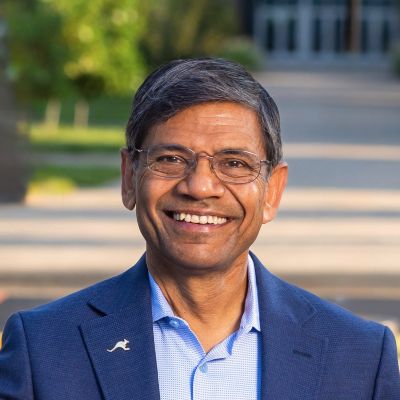
Mauli Agrawal is the is the 14th chancellor of the University of Missouri-Kansas City.
What are you excited for in your position as Chair of the USU Board?
I am most excited about the opportunity to work with university leaders across the nation to align more closely and advance the mission of urban serving institutions. These leaders are doing similar work in their own communities, and there is tremendous value in working together.
I also look forward to helping us communicate the importance of these institutions to students, the public, elected officials and other decision-makers, especially the role we play in educating the workforce of the future.
What is something you are working on at UMKC that is illustrative of the agenda and vision for urban-serving universities?
It is the continuing elevation of the entire university as Kansas City grows and evolves nationally and internationally. We want a university that keeps pace with that growth.
For us, it comes back to becoming an anchor institution for our community and elevating people’s economic, health, social and cultural prosperity.
Our Carnegie R1 research status, the National Science Foundation Critical Materials Crossroads Engines (the largest research award in university and state of Missouri history), athletics, student experiences and new buildings are all part of that effort. Together, they strengthen our ability to serve as an anchor institution.
What attracts you to urban universities?
Urban universities serve a broad community. Some of our students come from challenging backgrounds or schools, and we provide access to students who may not have the same opportunities at more elite universities. Seeing the outcome of that work is especially meaningful. When you stand on stage at graduation and see the joy on students’ faces, it is special. I have told people I could do this for 100 years. That is the kind of impact you can have in an urban area. At the same time, we attract outstanding students to outstanding programs. We serve a wide range of students, and that breadth is part of what draws me to this work
What does “urban serving” mean to you?
It can mean different things to different people, and I think that is all right. For some institutions in very large metropolitan areas, the focus may be entirely urban. In our setting, rural communities are close by. We cannot put a cocoon around ourselves and say we only serve a 10-mile radius.
We have a responsibility to serve the surrounding region, including through rural medicine and other areas. We are urban-based, and we should never forget our roots. As I said at our UMKC State of the University in September, our roots run deep here, and that gives us the stability to reach widely and serve people throughout the region.
How has USU benefited you and your institution?
We focus on many of the same priorities, and student success is a major one. USU’s programs and the studies it conducts produce findings that are shared across institutions and can inform our work. Another important benefit is the opportunity for presidents and chancellors to come together for open discussions about the issues we face. I enjoy engaging with leaders from across the country, learning whether they are facing similar challenges and hearing about the solutions they are considering. I believe there is more we can do, and I look forward to working on that as chair.
Stay Connected
X (formerly Twitter)
Facebook
YouTube
LinkedIn
RSS