
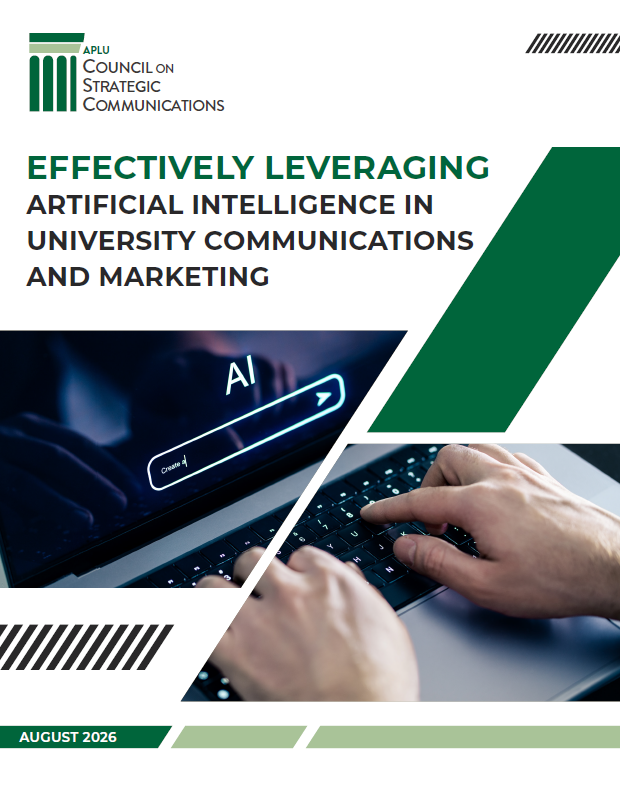
Effectively Leveraging AI in University Communications and Marketing
Public and land-grant university communications and marketing leaders face an array of questions and challenges when thinking through how to safely leverage AI to increase the effectiveness of their divisions. With the recognition that the landscape of AI tools is rapidly evolving, this playbook aims to provide communications and marketing leaders with a framework for exploring the opportunities and limitations of AI for their teams and divisions.
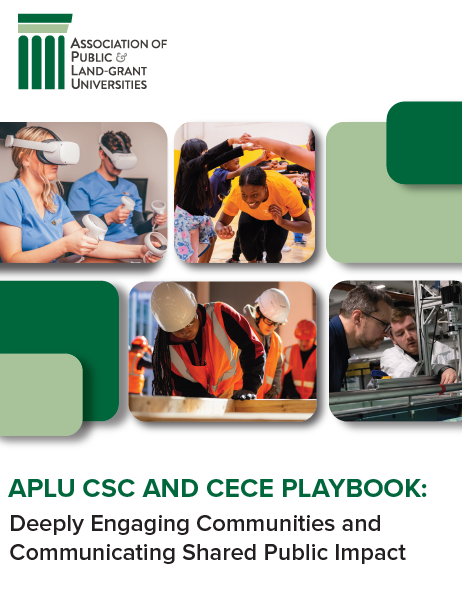
APLU CSC and CECE Playbook:
Deeply Engaging Communities and Communicating Shared Impact
This playbook, a collaboration between APLU’s Council on Strategic Communications and Commission on Economic and Community Engagement, aims to help institutions consider how they can best engage their communities for shared impact and more effectively demonstrate how this collective impact creates more vibrant, prosperous, and healthy communities.
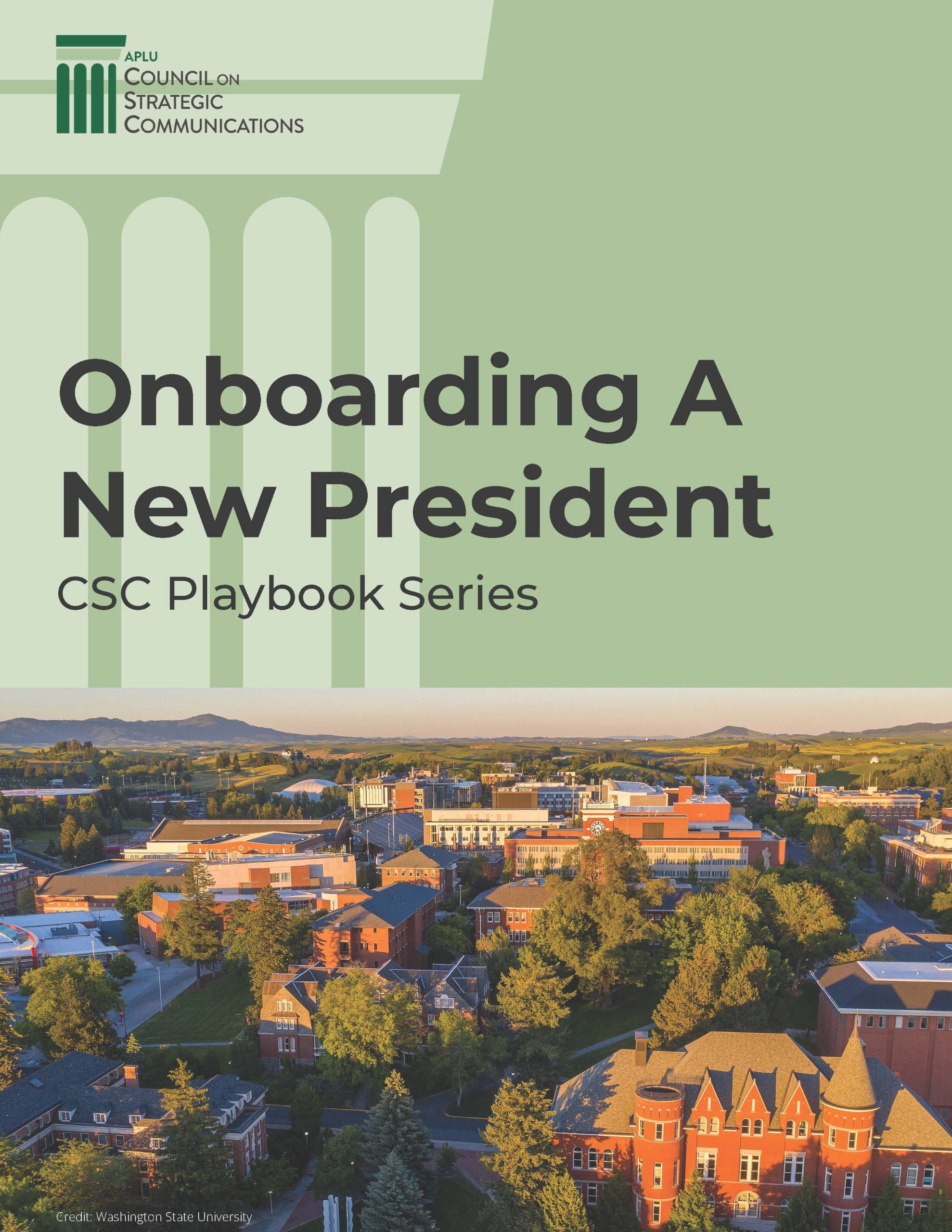
Onboarding a New President
A change in presidential leadership at a university represents a new era for an institution filled with both new opportunities as well as challenges. Strategic communications leaders on campus are uniquely positioned to help the university’s new leader share their vision, build meaningful connections with students, faculty, donors, and other stakeholders, and assuage any unsettledness about the direction of the institution.
When to Issue Presidential Statements
Public university presidents and chancellors face intensifying pressure from groups both on and off campus to issue a growing number of statements on events such as mass shootings, natural disasters, student deaths, hateful remarks, Supreme Court decisions, and much, much more. At the same time, other members of the campus community complain of flooded inboxes or statements that aren’t matched with actions.
Active Shooter—Prepare, Respond, & Recover
Tragically, active shooter events on college campuses are something for which every institution must prepare. APLU’s Council on Strategic Communications has developed a series of playbooks, with support and expertise from Blue Moon Consulting Group, to help you begin to think about the work your campus needs to do to prepare for, respond to, and recover from such a tragic event. Our goal is to share with our members best practice and lessons learned from peer institutions with a specific focus on emergency and strategic communications.
This series is comprised of three parts:
Part 1: Prepare — Building for an Effective Response
Part 2: Respond — Meeting the Immediate Information Needs of Your Community
Part 3: Recover — Providing the Emotional, Humanitarian, and Strategic Support
Necessary to Move Forward
Part 1: Prepare: Building for an Effective Response
In an active shooter situation, clear, timely, aligned, and consistent communication is absolutely critical both for the response itself as well as the perception of the response. How you meet the communications needs of various stakeholders can make a difference in the effectiveness of the emergency response. How the university responds, from the first critical moments to the days, months, and even years of recovery, will shape the perceptions of the actions, decision-making, credibility, and overall leadership of an institution.
Part 2: Respond: Meeting the Immediate Information Needs of Your Community
When an active shooter situation unfolds, time is critical. Campus communicators must transition instantly from their normal roles into action – requiring not only the execution of pre-developed communication plans but also the flexibility and agility to adapt in real-time. During the early stages of such an event, the safety of students, staff, and faculty is paramount. Providing accurate, frequent, and transparent updates is essential to saving lives, calming fears, and stopping the spread of misinformation. In this moment, your university needs you to be a proactive thought leader helping to guide the decision-making process. By driving the communication strategy, you will help to ensure your stakeholders continue to see the institution as transparent, empathetic, and in control.
Part 3: Recover:
Providing the Emotional,
Humanitarian, and Strategic Support Necessary to Move Forward
The aftermath of an active shooter event leaves a campus grappling with profound grief, fear, and uncertainty. But unlike the plans that may exist for the immediate response, it is unlikely that your institution has much in place to address the weeks, months, and years that lie ahead. Recovery is a long-term process. This is where communications professionals truly demonstrate their value by shaping how the institution supports the emotional and humanitarian needs of its community, while also managing operational and strategic priorities.
Evaluating the Optimal Marketing and Communications Structure for Your Institution
Designing the best structure for university marketing and communications operations is a common and often perplexing question facing senior leaders at public universities. Most institutions operate along a continuum – from more centralized to more decentralized models.
There is no “right” structure for all institutions, and the optimal model for a given institution is highly dependent on institutional context, culture, resources, and needs. Rather than offering a suggested model for institutions to adopt, this playbook provides a framework for institutions to use when evaluating the right approach for their institution.
Stay Connected
X (formerly Twitter)
Facebook
YouTube
LinkedIn
RSS