How much do in-state students pay in tuition and fees to attend four-year public universities?
Key Takeaways
- Published in-state tuition and fees at public four-year universities average $11,950, lower than a decade ago after accounting for inflation. Yet many students pay less.
- On average, in-state students at public four-year institutions paid just $2,300 in tuition and fees after scholarships, grants, and tax benefits. This net cost is nearly 50% lower than a decade ago after inflation.
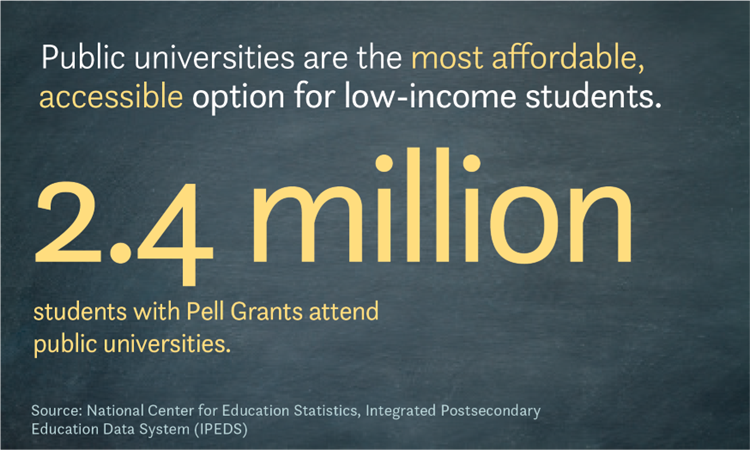
- 2.4 million or more than one in three students at public universities receive Pell Grants, federal grants aimed at helping low-income students access college.
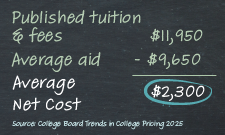
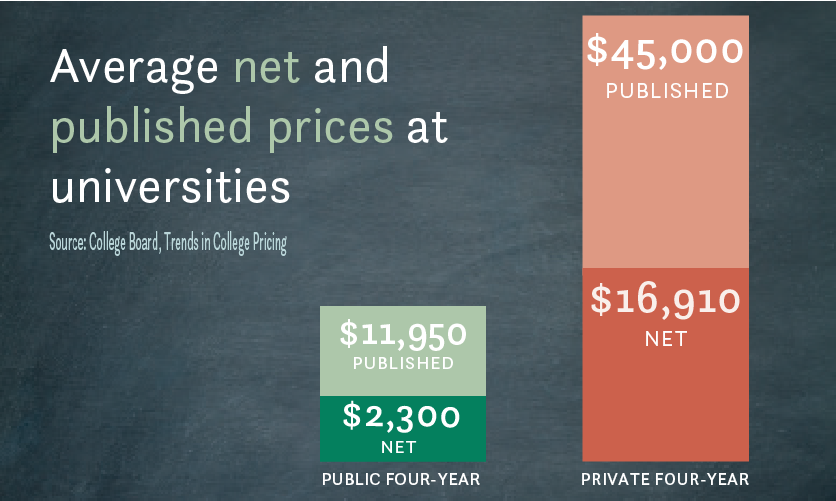
Published in-state tuition and fees at public four-year universities averaged $11,950, compared with $45,000 at four-year, private nonprofit universities. These prices rarely reflect the actual cost students pay.1
On average, in-state students at public four-year institutions paid just $2,300 in tuition and fees, compared with $16,910 at four-year, private nonprofit universities. This cost, known as average net price, reflects the actual cost of tuition after scholarships, grants, and tax benefits have been taken into consideration.1
A full-time student at a public four-year institution received an average of $9,650 in grant aid and tax benefits . Grant aid includes federal programs like Pell Grants and veteran’s benefits, as well as state and institutional grants and scholarships.1
An Investment, In Perspective
While public universities continue to provide the most affordable path to a quality higher education and the associated benefits, steep cuts in state funding have pressured public institutions to increase tuition in order to make up some of the loses in state funding. Graduates begin reaping those benefits soon after completing their degrees and they continue to accrue over their lifetime. In fact, median lifetime earnings of bachelor’s degree recipients are 65 percent higher than those with only a high school diploma. According to research from the Federal Reserve Bank of New York, investing in stocks has yielded an annual return of 7 percent since 1950 and the return for a college degree today is about 14 percent.2
While public universities continue to provide the most affordable way to receive a quality higher education to help realize these benefits, steep cuts in state funding in past recessions have pressured public institutions to make up some of their lost funding through tuition increases in recent decades. On an inflation-adjusted basis, appropriations per full-time student remain nearly 10 percent lower than they were in 2001.4

1 College Board, Trends in College Pricing and Student Aid, 2024.
2Abel and Deitz, “Despite Rising Costs, College Is Still a Good Investment” Federal Reserve Bank of New York, 2019.
3State Higher Education Finance Report, State Higher Education Executive Officers Association, 2022
Featured Project & Initiative
Featured Publication

Stay Connected
X (formerly Twitter)
Facebook
YouTube
LinkedIn
RSS