


When the federal government awards a grant to a university to conduct research, it provides funding for project costs like researchers’ pay and research supplies as well as support for significant research-related costs that are shared across many projects. Think of costs like using cutting-edge research lab space, high-speed data processing, or security measures to safeguard research projects. These costs are not easily assignable to any one specific grant.
[Infographic: Costs of Federal Research]
The federal government reimburses institutions for these Facilities and Administrative (F&A) costs, according to an audited rate that is capped by federal regulations. When reimbursing grantees for F&A costs, the federal government takes on a much smaller share of these costs than when research is conducted at government-owned facilities such as the National Labs, where taxpayers pay the full cost of all components of research.
[Two-Pager: Facilities & Administrative (F&A) Costs of Research]
This approach allows the federal government to efficiently support world-leading scientists across the country to advance breakthroughs in scientific and medical fields that are critical to U.S. competitiveness. Cutting F&A costs would imperil critical U.S.-led research breakthroughs at a moment of fierce global competition for research and innovation dominance.
[Video Explainer: Facilities & Administrative Costs]
Examples of costs F&A reimbursements cover:
- Patient safety such as human subjects protections;
- National security protections such as export controls;
- State-of-the art research laboratories;
- High-speed data processing;
- Radiation safety and hazardous waste disposal;
- Personnel required to support essential administrative and regulatory compliance work, maintenance staff, and other activities necessary for supporting research.
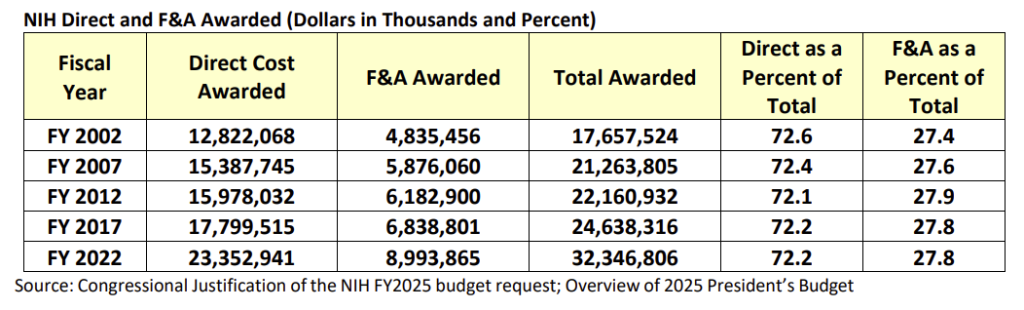
F&A costs – also referred to as “indirect costs” – are essential costs of conducting research. When the federal government awards a grant to a university to undertake cutting-edge research, a portion of the funding supports the required research infrastructure that has made the American research enterprise the best in the world. The vast majority of a grant budget (typically 67-75 percent)directly supports researcher salaries, graduate students, equipment, and supplies. Another portion of the grant (typically 25-33 percent) covers necessary research infrastructure and operating expenses that the university provides to support the pathbreaking research.
F&A costs are research costs. The federal government has partnered with universities since WWII to conduct research advancing the national interest. This research aims to meeting specific national goals such as health and welfare, economic growth, and national security. Universities – not the federal government – assume the risk of building the necessary infrastructure to compete for federal research grants. When a researcher at a university is awarded a grant, the federal government reimburses a part of the associated infrastructure costs that are incurred as part of the research.
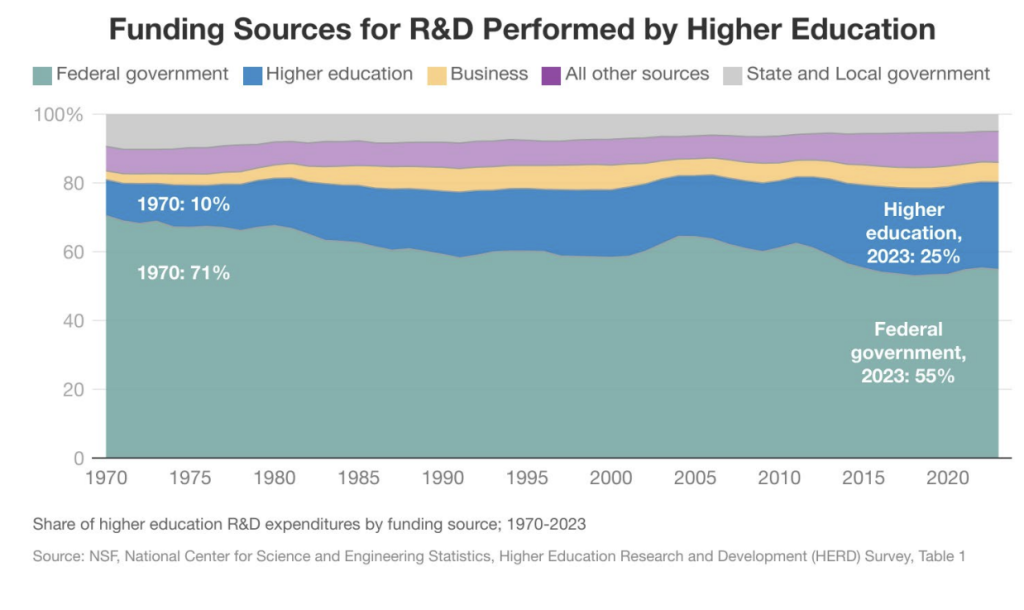
Yes. Universities are the number two supporter the academic research and development (R&D) on campuses, accounting for a quarter of all university research.
These institutional commitments to academic R&D significantly exceed the combined total of all other non-federal sources of support for academic R&D. Reimbursement for F&A costs associated with federal research is essential to the U.S. continuing to lead the world in critical sectors such AI, quantum computing, biotechnology, and other strategically important fields.
No, public universities are non-profit entities and do not financially gain from their F&A reimbursement. Federal regulations limit these reimbursements for costs incurred by universities in conducting research on behalf of the government. In fact, universities are not even fully reimbursed for the expenses they incur to provide the necessary infrastructure and support to conduct federal research
Increasing. Over the past several years, the amount of institutional support in real dollars that colleges and universities provide for research conducted by their faculty has grown 65 percent since 2010, faster than any other sector, including the federal government which has seen only 13 percent growth since 2010.
The increase in institutions’ support for the R&D they conduct is due in part to the rising compliance costs associated with increased federal research regulations in areas such as human subject protection, export control compliance, and ensuring research security and integrity. The federal government has capped the amount universities can be reimbursed since 1991. This cap only applies to higher education institutions. Unlike other sectors that conduct government research, universities must subsidize growing compliance costs from their own financial resources.
No. F&A costs recovered by research institutions have remained flat for over 20 years. For example, the National Institutes of Health’s percent of total funding going towards F&A cost reimbursements has remained unchanged, at approximately 27-28 percent of total funding, for more than two decades
Past studies suggest that proportionately, F&A expenses for university research are slightly less than those for other research performers. The most recent analysis, one by the RAND Corporation, found universities had the lowest percentage total research costs classified as F&A (31 percent). Federal laboratories were somewhat higher at 33 percent and industrial laboratories were higher still at 36 percent. The university community welcomes an updated analysis of these costs across sectors. The federal government has smartly invested in university-based research: F&A costs at universities are lower than other sectors, the government does not pay a profit to universities like it must for industry research performers, there is a university-specific cap on the amount the government will cover for administrative expenses, and the system of agency oversight ensures universities continue to be excellent stewards of federal taxpayers’ dollars.
Absolutely not. OMB rules (2 CFR Part 200 – Uniform Administrative Requirements, Cost Principles, and Audit Requirements for Federal Awards) require that F&A cost reimbursement rates only be based on research facilities, operations, and support used by federally funded research, not education or other university facilities or activities.
No. A university’s F&A cost rate is not a percent of the total grant, but rather a percentage only a subset of the research project’s direct costs. Currently, the average amount paid to universities for F&A expenses is approximately 25-33 percent of the total amount of a grant. (Campuses with medical centers tend to be closer to 33 percent because of the higher costs involved in providing for medical research facilities.)
Universities have a limited number of funding sources. The primary funding sources for research universities to fulfill their educational missions of teaching, research, and service are: tuition, research grants, cooperative agreements and contracts, philanthropy, endowment income, and state appropriations.
A reduction of federal F&A cost reimbursements would result in one or more of the following:
- An increase in tuition rates.
- The inability of universities to accept research awards from, and conduct research on behalf of, federal agencies;
- The deterioration of research facilities as the financial risk to build new facilities or maintain existing ones becomes too great to cover with institutional funds;
- The inability to sustain required support staff and infrastructure required to comply with government regulations; this could threaten the health and safety of patients, researchers and students;
- A reduction in the pipeline of trained scientists and engineers in the workforce due to reduced research training opportunities at universities.
Bottom Line: Cuts to F&A research costs are cuts to research. If such cuts are made, they will reduce the amount of research universities and their scientists can conduct on behalf of the federal government to achieve key national goals to improve the health and welfare of the American people, grow the economy, and enhance our national security.
Stay Connected
X (formerly Twitter)
Facebook
YouTube
LinkedIn
RSS