
A Decade of Success: Findings from 10 Years of APLU’s Degree Completion Award
APLU Impact
- The report includes an analysis of 154 Degree Completion Award submissions from 90 public and land-grant universities.
- APLU identifies the institutional systems, advising models, financial strategies, and support structures most frequently associated with improved student completion.
- Findings document a decade-long shift from isolated student success programs to coordinated, institution-wide approaches centered on degree completion and student persistence.
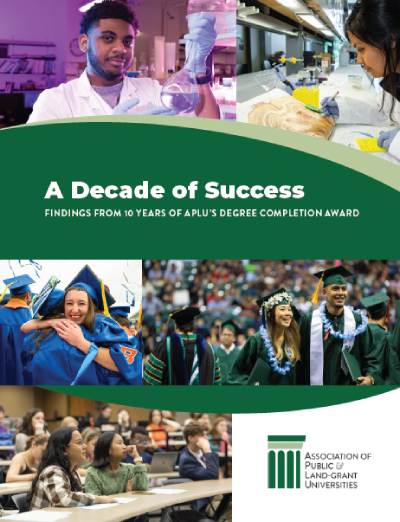
From 2015 to 2024, APLU’s Degree Completion Award recognized public universities that demonstrated measurable progress in improving student retention, persistence, and degree completion. A Decade of Success: Findings from 10 Years of APLU’s Degree Completion Award examines 154 award submissions from 90 universities to identify the institutional strategies and systems that most consistently supported student success.
The report documents how public and land-grant universities evolved their approaches to student completion over the course of a decade. Early efforts often focused on first-year retention initiatives and targeted student support programs. Over time, institutions expanded these efforts into more coordinated, institution-wide systems that aligned advising, academic pathways, financial support, and student services around shared student success goals.
Drawing on submissions from institutions of varying sizes and missions, the report identifies recurring themes that shaped institutional progress, including:
- Coordinated cross-campus leadership and student success infrastructure
- Data-informed advising and predictive analytics systems
- Guided academic pathways and momentum-focused curriculum design
- Completion-focused financial aid and emergency support strategies
- Holistic student wellbeing and embedded support services
- Reengagement initiatives for stopped-out, transfer, and adult learners
Rather than presenting a single model for improving completion, the report highlights how institutions increasingly approached student success as a shared institutional responsibility requiring collaboration across academic affairs, student affairs, advising, financial aid, and administrative leadership.
The findings also demonstrate how degree completion moved from isolated programmatic interventions toward integrated institutional systems designed to proactively identify barriers, coordinate support, and sustain student momentum through graduation.
Stay Connected
X (formerly Twitter)
Facebook
YouTube
LinkedIn
RSS