
/wp-content/uploads/page-bg-internal.jpg
Our Work

APLU Public Impact Research (PIR) Award

The APLU Public Impact Research Award recognizes an APLU member that has implemented one or more impactful Public Impact Research (PIR) efforts that have produced exceptional outcomes. PIR is a broad label to describe how university research improves lives and serves society at the local, regional, national, and global levels. Applications are due by 11:59 PM local time on Friday, June 26, 2026.

PIR is a broad and inclusive term encompassing multi-disciplinary research, community-engaged research, research grand challenges, research-practice partnerships, participatory research, translational and use-inspired research, co-production, and other approaches.

Criteria for the Award include: connection to public need, leveraged resources, evidence of impact, and sustainability. Use the menus below to learn the submission criteria.
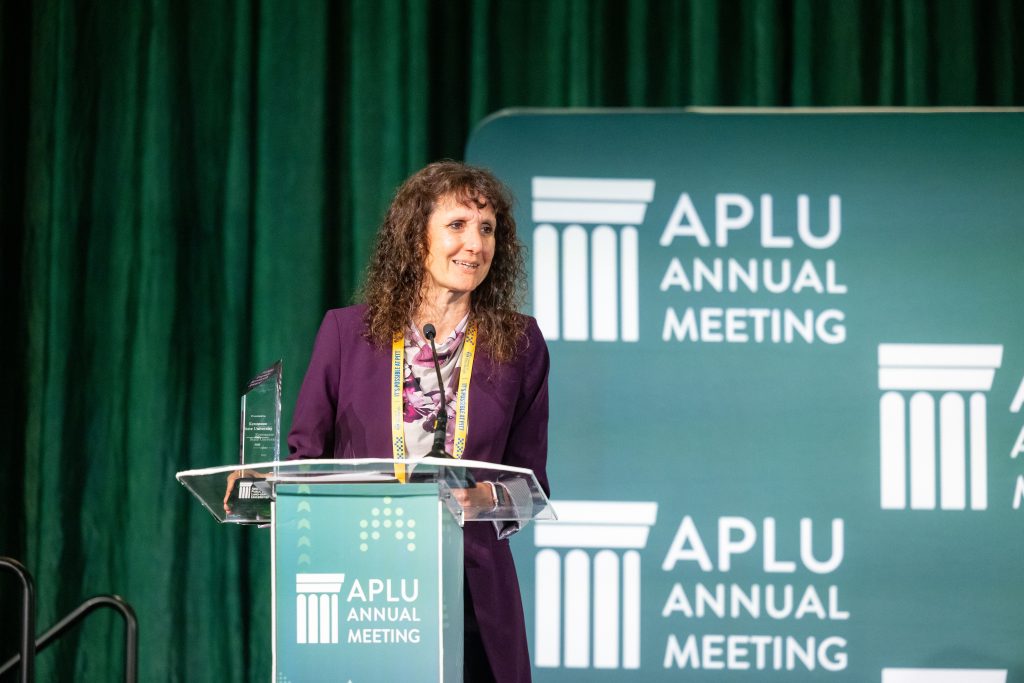
This award is intended to recognize a university that has implemented one or more impactful Public Impact Research (PIR) efforts that have produced exceptional outcomes. The program must have been active within the last five years to be considered.

Eligible PIR initiatives may be coordinated, multi-year, multi-project efforts or they may be individual projects, so long as they are focused on community/public impact. (Note: If an individual project is nominated, it will be important to communicate the potential replicability and scalability of the project in other contexts.)

If a program is a multi-institutional effort, the submission should describe the responsibilities of each party and identify a ‘prime’ representative organization to work directly with APLU and physically accept the award at the Annual Meeting.

As APLU defined it in 2019, PIR is any research that benefits the public. For example, this may include developing new medications, addressing environmental challenges impacting a local community, or examining disparities in education access and economic development to inform policy. PIR is a broad and inclusive term that encompasses multi-disciplinary research, community-engaged research, research grand challenges, research-practice partnerships, participatory research, translational and use-inspired research, coproduction, and other approaches.

Nominations of PIR initiatives across all APLU members are welcome.

Criteria weighed in the selection process include the following:

  • Connection to Public Need— Nominated research initiatives should be intentionally tuned to specific public needs via direct and ongoing engagement.
  • Leveraged Resources— Programs that judiciously use available resources to develop and implement their programs, which have the potential to be scaled by others, will be valued.
  • Evidence of Impact— The demonstrated and measured impact of a nominated initiative, as well as the number of persons/groups benefiting from it, will carry weight in the selection. For those projects that work directly with a specific community, attestation of impact by community leaders is particularly valued.
  • Sustainability – Public impact research benefits, and benefits from, a strong and sustainable two-way relationship between the university and the public.  Programs that show either sustainable past or planned future actions will be valued.

Criteria will be judged by a committee consisting of volunteer members of the APLU Council on Research Executive and Awards Committees, and may include external public impact research experts

Self-nominations are welcome (i.e., the senior research officer may nominate her/his own university). In fact, self-nominations are expected to be the norm, given the types of information required to substantiate the nomination (see below). The nomination must be submitted by the institution’s senior research officer, and only one nomination per institution or multi-institution consortium is accepted.

  • Nomination cover page, which must include:
    • The institution being nominated
    • Name of the program being nominated
    • Name, title, affiliation, and contact information of the nominator (senior research officer)
    • A statement to the following effect: “If selected, the SRO of the nominated (or for multi-institution submissions, ‘prime’) institution agrees to be available to accept the award and present the initiative at the subsequent APLU annual meeting (or agrees to arrange for a suitable institutional substitute).” For this award cycle, the APLU PIR award will be bestowed during the association-wide Awards session at the 2026 APLU Annual Meeting in San Antonio, TX between November 15-17, 2026.
  • Program description section (7 pages total), which must include:
    • Overview of the initiative (not to exceed 1 page)
      • Brief abstract of initiative suitable for public audiences
      • Identify the initiative leader(s) and their roles (Director, PI, etc.)
    • Narrative (not to exceed 6 pages): A description of the program objectives, the coalition of stakeholders involved, methodology, and impact of the initiative with sufficient information to assess the award criteria:
      • Connection to Public Need
      • Leveraged Resources
      • Evidence of Impact
      • Sustainability
  • Testimonials/Endorsements (does not count against page limits):
    • One (1) letter of endorsement from the president/chancellor/rector of the participating institution, or the prime institution of a multi-institution collaboration
    • If a cross-institutional effort, one (1) letter of endorsement from each non-prime participating organization’s leadership at the Senior Research Officer level or higher.
    • No more than two (2) additional letters of support may be included from persons impacted by the initiative or from other public/community leaders who can substantiate the initiative’s impact

APLU PIR Application GivePulse Tutorial


Prior Public Impact Research Awardees